The following projects are currently seeking participants to take part in research.
Please make sure your read the study details to see if you meet the criteria for taking part.
Hearing Loss, Wellbeing and Music
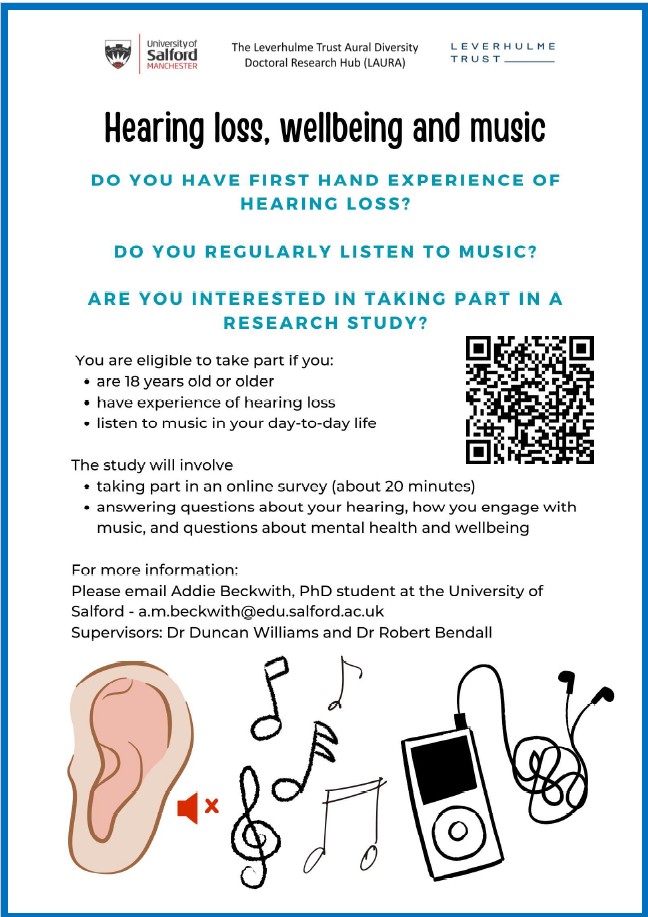 Do you have first hand experience of hearing loss?
- Do you regularly listen to music?
- Are you interested in taking part in a research study?
You are eligible to take part if:
- you are 18 years old
- have experience of hearing loss
- listen to music in your day-to-day life
This study will involve:
- taking part in an online survey (about 20 minutes)
- answering questions about your hearing, how you engage with music, and question about mental health and wellbeing
To take part, visit: https://app.onlinesurveys.jisc.ac.uk/s/salford/hearing-loss-wellbeing-and-music or use the QR code on the attached flyer.
For more information, please contact Addie Beckwith PhD student at the University of Salford: a.m.beckwith@edu.salford.ac.uk
Supervisors: Dr Duncan Williams and Dr Robert Bendall
Participants with Meniere's Needed to Help Develop a New Vestibular Rehabilitation Tool
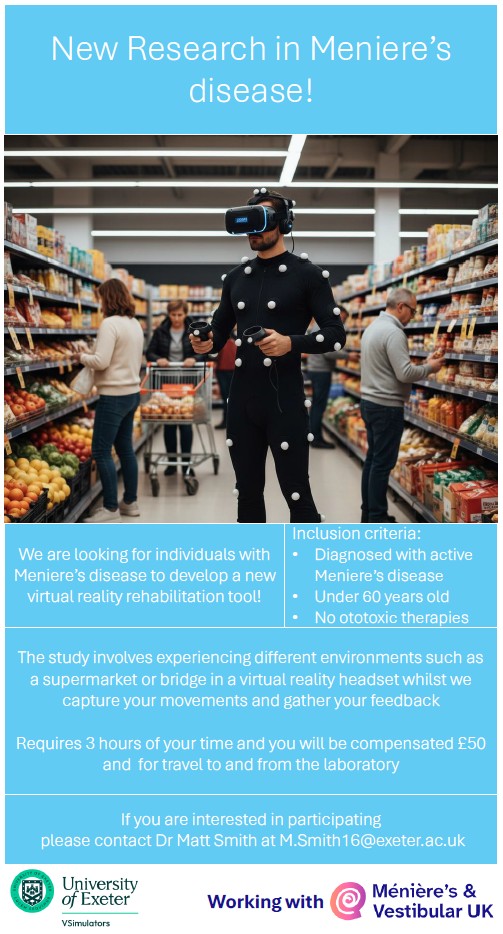 Individuals with active Meniere’s are invited to take part in a new research study.
Conducted at the University of Exeter, the study aims to develop a novel virtual reality-based rehabilitation tool.
Participants will be exposed to different environments that have been identified as potentially triggering such as busy supermarkets or bridges.
We hope that the development of this tool will enable individuals with Meniere’s to be able to move around in these spaces with reduced fear of symptom onset.
Please click here to read the participant information sheet
If you have any questions or are interested in participating in this study, please contact Dr Matt Smith at m.smith16@exeter.ac.uk
What are Potential Effects of Immersive LED Screen Experiences Inside a Passenger Corridor in an Elizabeth Line Station in Central London
UCL is carrying out research for Transport for London to investigate whether such an environment (see title) might provoke unintended responses and reactions in people with sensitivities to visual stimuli.
We seek to recruit individuals over the age of 18 who are “sensitive to immersive visual environments”.
To help us ensure we include as diverse of a group as possible, please use the link that best describes your condition:
What will the experiment involve?
Participants will take part in this experiment at UCL PEARL which will involve being inside a 1:1 scale model of a passenger platform access corridor (10m long, diameter 4.5m) lined with LED screens, with lead-in and lead-out spaces, and which will be placed inside the PEARL facility at Dagenham, East London.
This experiment will be done in 2 parts (Part 1 Stationary & Part 2 Moving (walking up & down the corridor) on consecutive experiment dates and will take about 1 hour during each session. Experiments will take place between 19 and 28 November (in the mornings). Participants will be compensated £100 (which includes any transportation cost), for each time they visit. Participants must be familiar with using public transport in general and be familiar with using London’s Underground stations.
If you would like to take part, please click on the link that applies to you above or contact UCL PEARL: pearl-experiments@ucl.ac.uk with your condition and preferred consecutive dates (only if you are unable to use the links). We will respond to check your eligibility and make corresponding arrangements.
Places are filled on a first come first served basis.
NITROVest - Vertigo or Dizziness? Do you have a diagnosis of vestibular migraine?
We are looking for men and women aged 18-65 who have vestibular migraine, as well as volunteers who never get headaches.
The study involves 2-3 sessions in the Clinical Research Facility at King’s College Hospital. On day one (2-3h), past medical history, neurological examination and balance tests will take place. In the next visit, either nitroglycerin or saline will be administered through a drip, and balance re-tested. Participants will also complete a diary for one month.
For more information, please contact dizziness@kcl.ac.uk or visit dizziness-research.com/
IRAS Project ID: 312478
Do You Have a Diagnosed Balance Disorder or Experience Balance Problems?
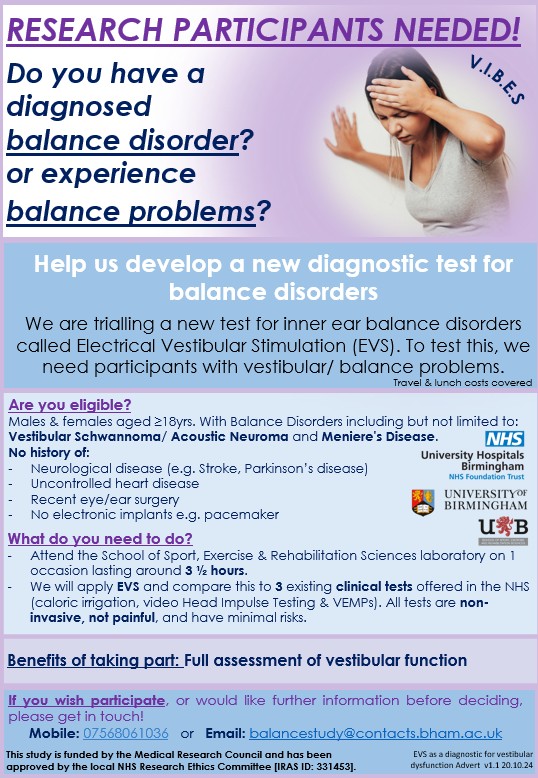 We're running a clinical trial at the University of Birmingham aimed at improving how balance disorders—like Ménière’s Disease—are assessed and diagnosed. If you’ve been living with the challenges of Ménière’s, your involvement could directly contribute to developing a faster, more reliable test for Ménière’s disease. Current balance tests cannot diagnose Ménière’s Disease. Doctors use a combination of symptoms, signs and hearing tests together to diagnose this condition. Not all patients present in the same way making this condition difficult to diagnose.
Previous research has shown that this test may help to diagnose Meniere’s disease which may be useful when it’s unclear from the clinical presentation. The new test assesses balance function using weak, non-invasive electrical currents and measuring the eyes response. We hope to create a test that is both fast and accurate, helping clinicians better understand and manage this complex condition.
What’s involved:
• You'll undergo a full range of balance tests currently used in the NHS
• You’ll also try out our new, non-invasive balance test
• All sessions are supervised by a vestibular research specialist and an ear, nose and throat (ENT) clinical registrar
Location & Perks:
- Just a 5-minute walk from University Railway Station, Birmingham
- Free parking available
- We cover travel costs from across the whole of the UK
- Lunch is on us!
- Interested or want more info?
Please read our Participant Information Sheet
Contact: Email: balancestudy@contacts.bham.ac.uk or WhatsApp, text or call: 07568061036
Help Research About Dizziness
The Cardiff University Dizzy Lab are developing a new questionnaire to help clinicians and researchers better understand different triggers and environments that evoke dizziness (and the feelings of anxiety that sometimes accompany them).
The aim is to improve research, the consistency of diagnosis and the assessment of rehabilitation approaches.
Anyone who is experiencing dizziness of any kind can take part because we want to ensure our questionnaire can tell the difference between different conditions (e.g. PPPD, vestibular migraine, Meniere's Disease, BPPV, vestibular neuritis, etc). You need to be over 18 to take part.
The study has two stages: Stage 1 is a 15-minute survey and Stage 2 is an optional 5-minute follow-up two weeks later.
You can take the survey using this link, on computer, tablet or phone (the layout is better on bigger screens, but it should work fine on phones).
Please visit this link to find out more and take the survey: https://cardiffunipsych.eu.qualtrics.com/jfe/form/SV_bODOmZmlVJcuj4y
Thank you very much for participating.
Do You Have Persistent Postural Perceptual Disorder (3PD/PPPD)?
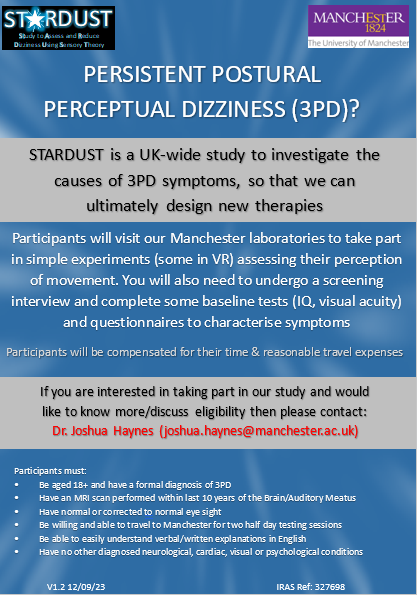 PARTICIPANTS REQUIRED: Volunteers required aged 18+ with a 3PD diagnosis and no cardiac, neurological, ophthalmological or psychiatric conditions
STARDUST is a UK-wide study to investigate the causes of 3PD symptoms, so that we can ultimately design new therapies
Participants will visit our Manchester laboratories to take part in simple experiments (some in VR) assessing their perception of movement. You will also need to undergo a screening interview and complete some baseline tests (IQ, visual acuity) and questionnaires to characterise symptoms.
Participants will be compensated for their time & reasonable travel expenses
If you are interested please contact: Dr. Joshua Haynes joshua.haynes@manchester.ac.uk to find out more.
Visit this link for more information.
Additionally, family and friends may wish to take part too as Control Participants are also needed for this study to help understand some of the causes of chronic dizziness.
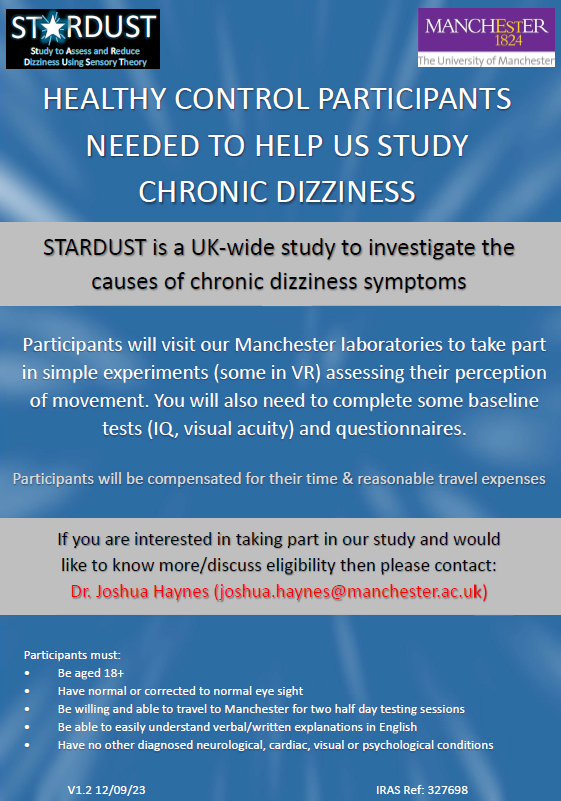 CONTROL PARTICIPANTS REQUIRED: Healthy volunteers required aged 18+ with normal or corrected to normal eyesight.
STARDUST is a UK-wide study to investigate the causes of chronic dizziness symptoms, so we can design new therapies.
Participants will visit our Manchester laboratories to take part in simple experiments (some in VR) assessing their perception of movement. You will also need to complete some baseline tests (IQ, visual acuity) and questionnaires.
Participants will be compensated for their time & reasonable travel expenses.
If you are interested please contact Dr. Joshua Haynes: joshua.haynes@manchester.ac.uk to find out more and visit this link for more information.
TELEREHAB - DSS Clinical Validation Study
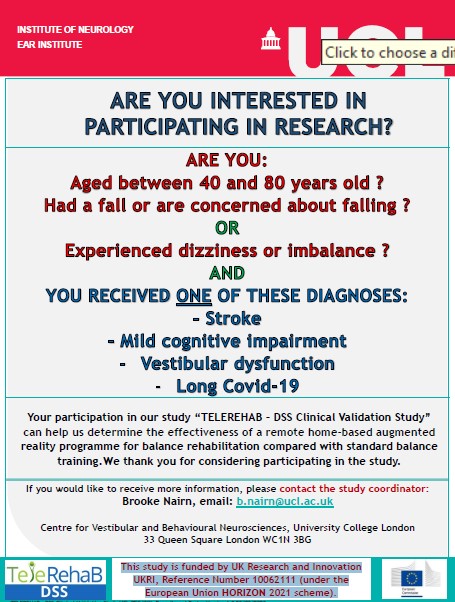 Are you aged between 40 and 80 years old?
- Had a fall or are concerned about falling?
OR
- Experienced dizziness or imbalance?
AND
You've received ONE of these diagnoses:
- Stroke
- Mild cognitive impairment
- Vestibular dysfunction
- Long Covid-19
Your participation in our study “TELEREHAB – DSS Clinical Validation Study” can help us determine the effectiveness of a remote home-based augmented reality programme for balance rehabilitation compared with standard balance training.
We thank you for considering participating in the study. If you would like to receive more information, please contact the study coordinator: Brooke Nairn, email: b.nairn@ucl.ac.uk
Centre for Vestibular and Behavioural Neurosciences, University College London 33 Queen Square London WC1N 3BG. This study is funded by UK Research and Innovation UKRI, Reference Number 10062111 (under the European Union HORIZON 2021 scheme).
More about the Ménière's & Vestibular UK Research Programme
I would like to find out out more about the Ménière's & Vestibular UK Research Programme
I would like to donate to the Research Fund
I would like to become a Research Supporter to support more vital vestibular research
Where can I get further information and support?
- Please contact us for more information - email us: info@meandve.org.uk or give us a ring: 01306 876883 to chat with a member of our team
- See your GP for advice if you have any question or concerns about your symptoms. They may refer to a specialist if neccessary
- Join us at one of our online Vestibular Insights events
- Become a member to receive regular information, resources and updates
- Donate to support our work and help us continue supporting people with vestibular conditions
Please note, Ménière's & Vestibular UK can provide general information, but is unable to provide specific medical advice. You should always check with your medical professional for information and advice relating to your symptoms/condition.
Help support research
Ménière’s & Vestibular UK relies on donations to enable us to fund essential research into vestibular disorders. Here's how you can help…